Thursday, 19 January 2017

Writing about women's journeys to be free from (domestic and gender) violence

Writing on analysis of women's intervention narratives, in a cold but lovely environment:

We explore the ways and senses that the participants attributed to the responses they received from the support systems in four countries (Germany, Portugal, Slovenia and UK), what was helpful for them, and what was not, if and how the professionals meet their expectations and/or needs, or, instead, they defrauded women.


The paper is organized in organized in 4 sections: 1) what helped and what didn’t help, from the point of view of the participants, will show/frame a picture of how  and when did women felt supported or defrauded by the intervention system in each country; in this section the analysis explores the access (or lack of) information about the victims possibilities to find help, the first contact with the support systems and the diverse encounters with the professionals; 2) the fulfillment of the duties of the State will discuss in which measure the actions identified in the first section meet or collide with the duties of the State or if they failed to meet the rights of the victims/ survivors; 3) How minority women framed culture/discriminatory responses due to cultural or migrant backgrounds, a section where it will be explored specific questions, needs and issues reported by women who experienced violence related with migrant or minority statuses; 4) On how the intervention enabled (or not) agency and resistance will be the section focusing the women’s journeys to autonomy and independence stressing the ways the support systems enabled or blocked their action to build their lives free of violence. In this sense it’s crucial for the intervention systems to validate the agencies and resistances of women in order to avoid revictimization and to develop efficient support resources and tools for helping and advocating them to rebuild their lives without violence.


The political consensus around the need for combatting domestic violence have increasingly acknowledge the rights of the victims in legal and policy. Nevertheless, the actualization of women’s rights in the pathways for a non-violent life is a more complex issue because it demands, in the day by day, bridging from the abstract individual — as constructed by the liberal legal and policy systems — and the concrete persons, situated in complex social relations and contexts (Benhabib 1992 and Hagemann-White 2016:  the ‘generalised other’ and the ‘concrete other’).

Moreover, women who experienced domestic violence in their intimate relationships, when they decide to follow a different pathway away from their abusive (ex-)partners, face a matrix of intertwined axis of ideologies and material constraints, such as the ‘familialism’ (Luxton 1987), the ideology of the “Ideal Mother” (Mathews, 1984), and the pervasive but often subtle and implicit race-prejudices and discrimination. In this, the realisation of the women (and children) victims’ rights is an arena of contested and continuous struggles to regain their lives.  


We also focus on the specificities of the experiences of women with cultural and/or migrant backgrounds through their paths in the intervention systems at the four countries. Departing from their accounts it was possible to frame their representations of belonging, violence and discrimination; their own perceptions of culture and how the cultural representations reproduced by professionals and intervention systems could compromise or help them. Also how the immigrant status and language could be barriers in their entrance and during their paths in the intervention systems: to came out of violent relationships, to find help and felt supported. Finally we highlight and reflected upon the positive outcomes of the BME services.  


Osnabruck, 19.Jan.2017


Sunday, 15 January 2017

Féelix Nussbaum in the 1930s and 1940s and the refugees in nowadays


Nussbaum was born in Osnabrück, Germany, in 1904, and died in Auschwitz in 9 August 1944, 39 years old. Before, he was taken to the detention camp Saint Cyprien, from where he managed to escape. He painted the reality of the destruction provoked by nazism.


Legend: Prisioners in Saint-Cyprien (1942)

Osnabrück has a Museum with the name of Félix Nussbaum, with much of his works. In 1995, the Osnabrück contest for the realisation of the Felix Nussbaum Haus was won by the American architect Daniel Libeskind. The extension based on plans by American architect Daniel Libeskind links the Cultural History Museum with the Felix Nussbaum Haus retaining the basic concept of the Felix Nussbaum Haus, opened in 1998. Materials of wood, concrete and zinc which determine the early building complexes of the Felix Nussbaum Haus, are complemented by a grey-coloured façade. The arrangement of the windows with their asymmetrically pointed shapes imitate the façade design of the Felix Nussbaum Haus, lending the building a distinctive appearance. While the extension gives visitors direct access to the Cultural History Museum, the exhibition rooms of the Felix Nussbaum Haus are reached via an enclosed glass corridor. In 2011 the Felix Nussbaum Haus and the Cultural History Museum Osnabrück opened their doors again after almost a year of reconstruction.


Legend: Self-portray with tea towel (dish towel) (around 1933)


Legend: Self Portrait with Jewish Identity Card (1943)

In this painting, I particularly like the white blossoms that appear in the top of the painting, as a sign of hope (for me, at least). 

The visit to Nussbaum Museum was a vivid experience about the tragedy of the nazism in Europe, but it also remembers me the situation of refugees in Europe in nowadays.

In Varusschlacht learning from history


I learnt many things about German and Romanian history in Germany.
The gold coins are amazing at the Museum in Varusschlacht


Great company with Carol Hagemann-White and Bianca Graffe.


Friday, 16 October 2015

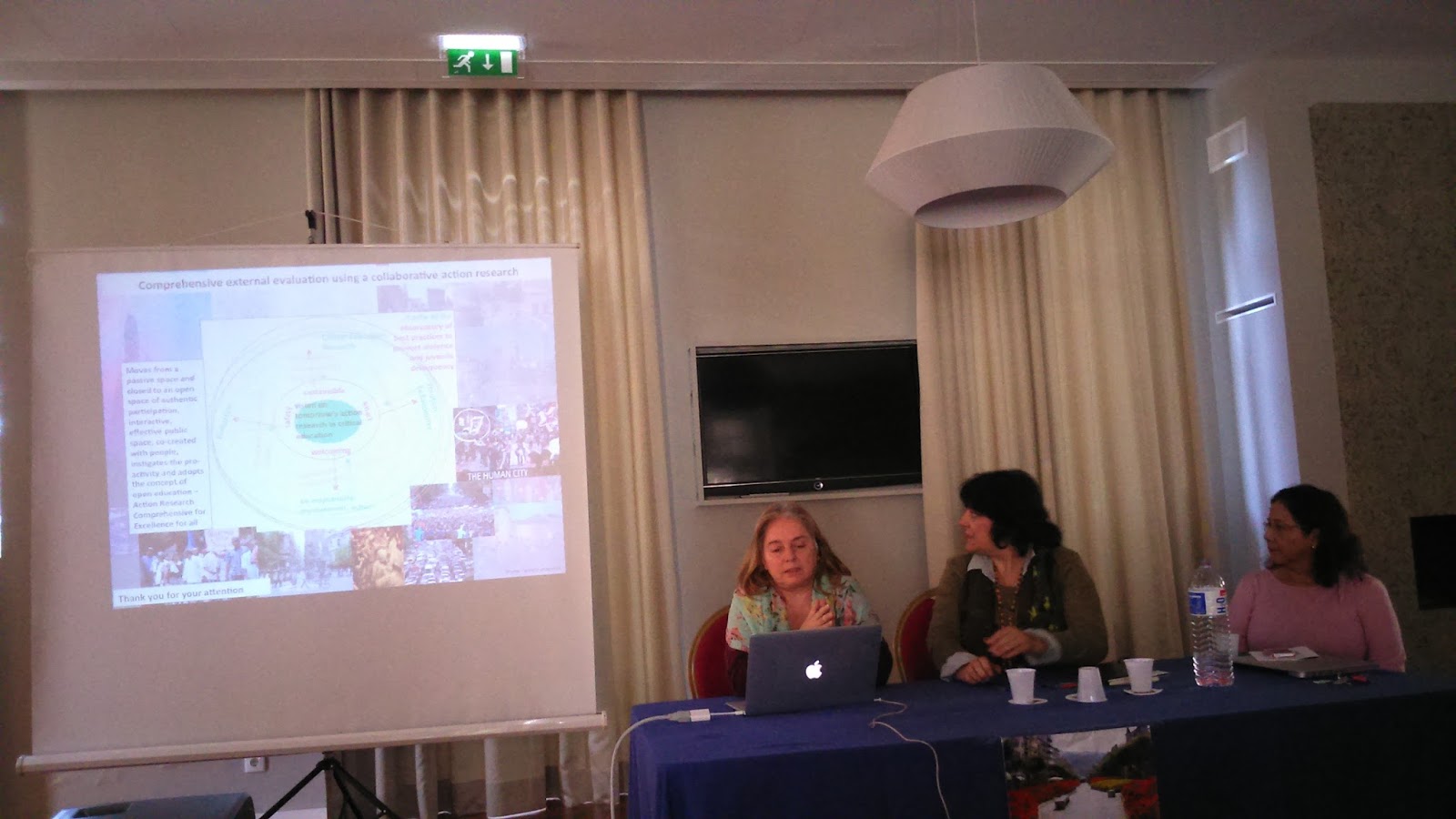
Preparing Action Research Paper


A "collective researcher" (in the words of Bataille) is already established to think about the action research process in the Project Artways in UMAR. The abstract of our paper:


Comprehensive external evaluation using a collaborative research-action methodology

Comprehensive external evaluation using a collaborative research-action methodology proposes the Social and community development research as a sensitizing and formative construct of the best practices for prevention of violence and juvenile delinquency. Aims to map the integration of all facilitators used in communication for the development of prevention of violence and juvenile delinquency in the key moments of realization of the ARTWAYS  project [1], according to the ERAC cycle (Evaluation; Research; Action; Collaborative) and the principles of transparency and credibility as a goal that guides the ARTWAYS Project. Subsequently to the time of completion of the project, it plans to establish prevention memory through artistic expression in order to facilitate the transfer of innovation to territories/places where environmental scenography claims the necessary to foster creative and competitive social cohesion, able to promote social inclusion for the essential defense of  human rights, inherent to the interests of human development progress.
We observe the relations network for strategic monitoring of the ARTWAYs Project actions, processed as a quality observatory of best practices to prevent violence and juvenile delinquency, through the collaborative research-action. The strategic monitoring system, which we propose for the  external evaluation, through a methodology of collaborative action research, is profiled with the relevance to promote its value in a continuously and systematically way.

Authors:
Isabel C. Viana
icviana@ie.uminho.pt
Institute of Education, University of Minho, Portugal
Maria José Magalhães
Faculty of Psychology and Sciences of Education, University of Porto, Portugal


[1] The project "Artways - Educational Policies and Training Against Violence and Juvenile Delinquency "is a project of UMAR, financed by the Financial Mechanism of the European Economic Area (EEA Grants) and managed by the Calouste Gulbenkian Foundation

Friday, 18 September 2015

Cultural studies and postcolonial feminist thought

The polysemy of the concept culture makes difficult to operationalize it when analyzing discursive material about power dynamics of gender relations.
Culture is heritage, inheritance.

Epistemological failures as an important layer of oppression.
"Highlighting the patterns of suppression and the corresponding impact of rendering black feminist though easily dismissed" (Dotson, 2015: 2323) mean placing black feminist thought in the focus or analysis.


"For Collins (2009: 302-305), engaging in epistemology is necessary for empowerment, particularly with respect to the operations of hegemonic power." ((Dotson, 2015: 2324)

Rosana Paulino, Embroideries, 1997.

"Hegemonic power, for Collins (2009: 302), 'aims to justify practices' in structural, disciplinary, and interpersonal domains of power." (Dotson, 2015: 2324) 

References:
Collins, Patricia Hill. 2009. Black Feminist Thought: Knowledge, Consciousness, and the
Politics of Empowerment. New York: Routledge Classics.
Dotson, Kristie (2015) "Inheriting Patricia Hill Collins's Black Feminist epistemology", Ethnic and Racial Studies 38:13, 2322-2328, DOI: 10.1080/01419870.2015.1058496. 


Tuesday, 8 September 2015

Symposium of the CEINAV at European Conference on Domestic Violence, Belfast 2015

Liz Kelly, Rita Lopez, Bianca Graffe and Vlasta Jalusic present the research of CEINAV in the Belfast European Conference on Domestic Violence.
In this symposium, preliminar findings of the CEINAV were presented, giving special attention to the research questions of the Project, that is the ways cultural encounters play out in ethics, justice and citizenship.
Although CEINAV focus on three forms of violence — domestic violence against women, child abuse and neglect and trafficking for sexual exploitation, the symposium was centred on domestic violence intervention in the forth countries involved in CEINAV: Germany, United Kingdom, Portugal and Slovenia.
Cultural encounters were approached with a methodology based on focus groups with professionals from several areas who were asked about the sequence of intervention and the specificities of intervention with survivors belonging to ethnic minorities groups.
The research of CEINAV can be followed at the blog http://ceinav-jrp.blogspot.pt/ as well as in the site http://www.fpce.up.pt/love_fear_power/ceinav/ceinav_eng.html