Sunday, 15 January 2017
In Varusschlacht learning from history
I learnt many things about German and Romanian history in Germany.
The gold coins are amazing at the Museum in Varusschlacht
Great company with Carol Hagemann-White and Bianca Graffe.
Friday, 16 October 2015
Preparing Action Research Paper
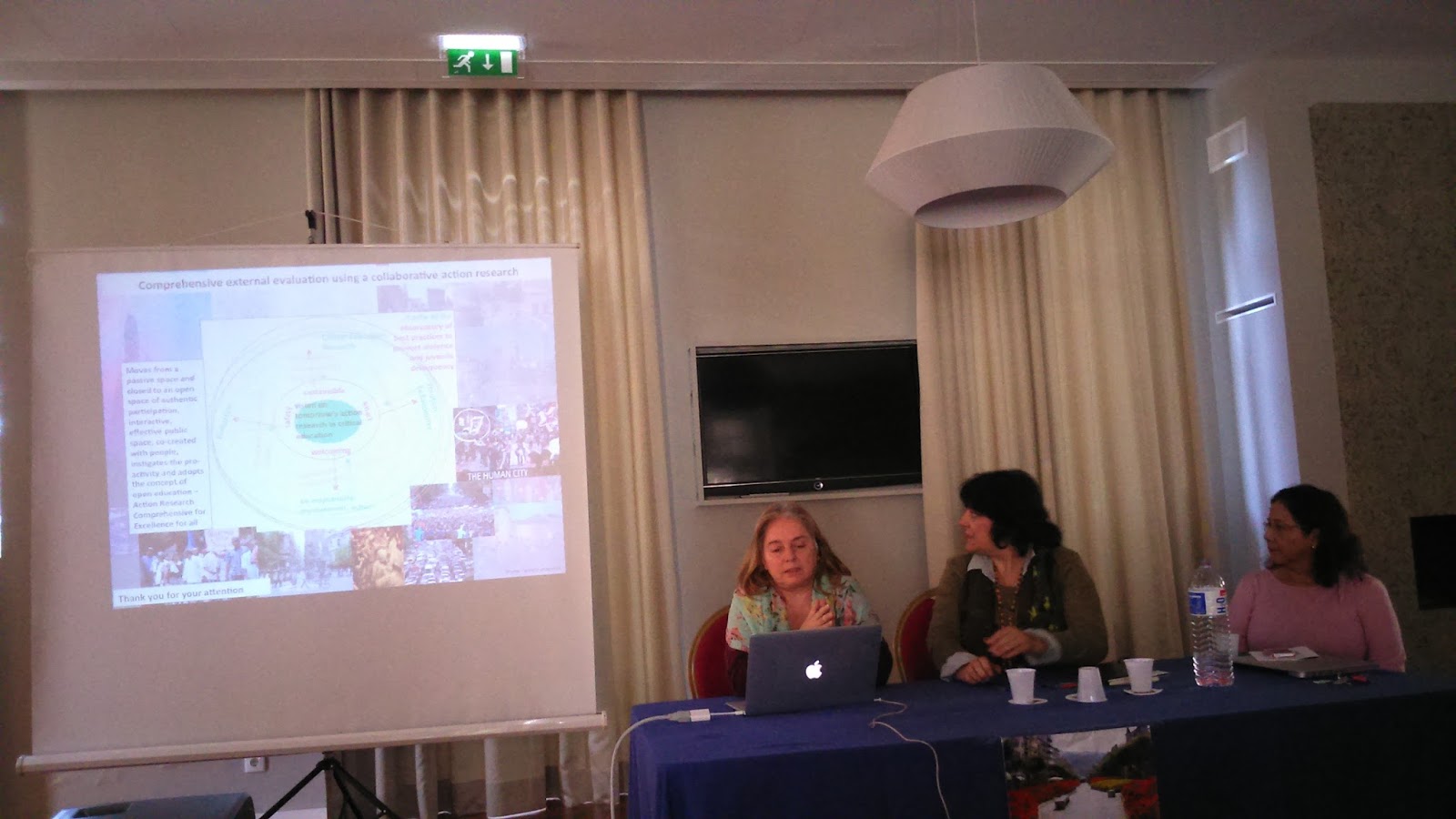
A "collective researcher" (in the words of Bataille) is already established to think about the action research process in the Project Artways in UMAR. The abstract of our paper:
Comprehensive external evaluation using a collaborative
research-action methodology
Comprehensive external
evaluation using a collaborative research-action methodology proposes the Social and community development research as a sensitizing and formative
construct of the best practices for prevention of violence and juvenile
delinquency. Aims to map the integration of all facilitators used in
communication for the development of prevention of violence and juvenile
delinquency in the key moments of realization of the ARTWAYS project [1],
according to the ERAC cycle (Evaluation;
Research; Action; Collaborative)
and the principles of transparency and credibility as a goal that guides the
ARTWAYS Project. Subsequently to the time of completion of the project, it plans
to establish prevention memory through artistic expression in order to
facilitate the transfer of innovation to territories/places where environmental
scenography claims the necessary to foster creative and competitive social
cohesion, able to promote social inclusion for the essential defense of human rights, inherent to the interests of
human development progress.
We observe the relations network for strategic
monitoring of the ARTWAYs Project actions, processed as a quality observatory
of best practices to prevent violence and juvenile delinquency, through the collaborative
research-action. The strategic monitoring system, which we propose for the external evaluation, through a methodology of
collaborative action research, is profiled with the relevance to promote its
value in a continuously and systematically way.
Authors:
Isabel C. Viana
icviana@ie.uminho.pt
Institute of Education, University of Minho, Portugal
Maria José
Magalhães
Faculty of Psychology and Sciences of Education,
University of Porto, Portugal
[1] The project
"Artways - Educational Policies and Training Against Violence and Juvenile
Delinquency "is a project of UMAR, financed by the Financial Mechanism of
the European Economic Area (EEA Grants) and managed by the Calouste Gulbenkian
Foundation
Friday, 9 October 2015
Friday, 18 September 2015
Cultural studies and postcolonial feminist thought
The polysemy of the concept culture makes difficult to operationalize it when analyzing discursive material about power dynamics of gender relations.
Culture is heritage, inheritance.
Epistemological failures as an important layer of oppression.
"Highlighting the patterns of suppression and the corresponding impact of rendering black feminist though easily dismissed" (Dotson, 2015: 2323) mean placing black feminist thought in the focus or analysis.
"For Collins (2009: 302-305), engaging in epistemology is necessary for empowerment, particularly with respect to the operations of hegemonic power." ((Dotson, 2015: 2324)
Culture is heritage, inheritance.
Epistemological failures as an important layer of oppression.
"Highlighting the patterns of suppression and the corresponding impact of rendering black feminist though easily dismissed" (Dotson, 2015: 2323) mean placing black feminist thought in the focus or analysis.
"For Collins (2009: 302-305), engaging in epistemology is necessary for empowerment, particularly with respect to the operations of hegemonic power." ((Dotson, 2015: 2324)
Rosana Paulino, Embroideries, 1997.
"Hegemonic power, for Collins (2009: 302), 'aims to justify practices' in structural, disciplinary, and interpersonal domains of power." (Dotson, 2015: 2324)
References:
Collins, Patricia Hill. 2009. Black Feminist Thought: Knowledge, Consciousness, and the
Politics of Empowerment. New York: Routledge Classics.
Dotson, Kristie (2015) "Inheriting Patricia Hill Collins's Black Feminist epistemology", Ethnic and Racial Studies, 38:13, 2322-2328, DOI: 10.1080/01419870.2015.1058496.
Tuesday, 8 September 2015
Symposium of the CEINAV at European Conference on Domestic Violence, Belfast 2015
Liz Kelly, Rita Lopez, Bianca Graffe and Vlasta Jalusic present the research of CEINAV in the Belfast European Conference on Domestic Violence.
In this symposium, preliminar findings of the CEINAV were presented, giving special attention to the research questions of the Project, that is the ways cultural encounters play out in ethics, justice and citizenship.
Although CEINAV focus on three forms of violence — domestic violence against women, child abuse and neglect and trafficking for sexual exploitation, the symposium was centred on domestic violence intervention in the forth countries involved in CEINAV: Germany, United Kingdom, Portugal and Slovenia.
Cultural encounters were approached with a methodology based on focus groups with professionals from several areas who were asked about the sequence of intervention and the specificities of intervention with survivors belonging to ethnic minorities groups.
The research of CEINAV can be followed at the blog http://ceinav-jrp.blogspot.pt/ as well as in the site http://www.fpce.up.pt/love_fear_power/ceinav/ceinav_eng.html
In this symposium, preliminar findings of the CEINAV were presented, giving special attention to the research questions of the Project, that is the ways cultural encounters play out in ethics, justice and citizenship.
Although CEINAV focus on three forms of violence — domestic violence against women, child abuse and neglect and trafficking for sexual exploitation, the symposium was centred on domestic violence intervention in the forth countries involved in CEINAV: Germany, United Kingdom, Portugal and Slovenia.
Cultural encounters were approached with a methodology based on focus groups with professionals from several areas who were asked about the sequence of intervention and the specificities of intervention with survivors belonging to ethnic minorities groups.
The research of CEINAV can be followed at the blog http://ceinav-jrp.blogspot.pt/ as well as in the site http://www.fpce.up.pt/love_fear_power/ceinav/ceinav_eng.html
Saturday, 15 August 2015
The Salt of the Earth - with Sebastião Salgado

I knew the 1954 movie Salt of the Earth, about a long strike, in 1961, in Mexico. It is a feminist film, showing women striking to support workers struggle for a better work conditions. The film shows how the miners, the company, and the police react during the strike. It's style is neorealist, the producers and director used actual miners and their families as actors in the film. It was a great movie that strengthened my radical feminist point of view and my solidarity with workers' movements.
Miners claimed equal payment and wages with Anglo workers as well as better health programmes for them and their families. Because of the fear of police, the miners' wives replaced them in the strike and stand there firmly into the end. Esperanza Quitero is one of the characters protrayed in the movie, played by Rosaura Revuletas.
I remembered the circle of women with small posters in their hands, and walking around all the day. Also the solidarity among them and from the neighbours to support with food, medicines and whatever they need to go on striking for so long time.
Tonight, I saw another The Salt of the Earth, a Brazilian-French and Italian biographical documentary directed by Wim Wenders — the director of Der Himmel über Berlin —, and Sebastião Salgado's son, Juliano Ribeiro Salgado. I knew some of the photographs of Sebastião Salgado but I didn't imagine how much he had worked. The movie received many awards, the Cannes Festival Special Prize and César Award for Best Documentary Film. In the team of the producers, there is also Wim Wenders, but also Lélia Wanick Salgado, Sebastião's wife, and David Rosier, Julia de Abreu, Fakhrya Fakhry, Andrea Gambetta and Christine Ponelle.

The movie shows how important his wife was in his career — Lélia Wanick Salgado.References:
Salt of the Earth (1954) written by Michael Wilson, directed by Herbert J. Biberman, and produced by Paul Jarrico.
Salt of the Earth (2014) written by Wim Wenders, Juliano Salgado and David Rosier, Directed by Wim Wenders and Juliano Salgado and produced by Wim Wenders, but also Lélia Wanick Salgado, Sebastião's wife, and David Rosier, Julia de Abreu, Fakhrya Fakhry, Andrea Gambetta and Christine Ponelle.
Sunday, 19 July 2015
Writing on feminist and queer movements
Prevention of gender violence and working against LGBT prejudices: the intersection between collective action and institutional dynamics
Fernando André Rosa – ISCTE-IUL, CIES, PT
Maria José Magalhães – FPCEUP-CIIE; CIEG, PT
Yolanda Rodríguez-Castro — UVigo, ES
Rita de Oliveira Braga Lopez — FPCEUP, PT
This study compares two public campaigns against LGBT prejudices: i) “Dislike Homophobic Bullying”, by CIG, the Portuguese Governmental mechanism for citizenship and gender equality; ii) The performative action "Exorcise the Pathologization", included in the Portuguese branch of the international campaign Stop Trans Patologization 2012. Using critical discourse analysis and visual analysis, we conclude that gender violence is a cross cultural and structural problem embracing a wide range of forms of violence against women and LGBT people in Portugal. It is grounded in a dominant culture where gender is socially constructed as polarized, complemented with the performativity of discourse, the intersectional and institutional power relations underlying social practices. We demonstrate how public campaigns against homo and transphobia can contribute for the des-naturalization of gender divide and gender regime and thus for the change of the cultural ground of gender violence. However, without deconstructing gender they are at risk of reproducing gender hierarchies.
Keywords: Gender violence; homophobic violence; critical visual analysis; feminism; agency, heteronormativity.
Subscribe to:
Posts (Atom)